Pope Leo meets 2.5 million in Buenos Aires amid economic tension
The pontiff held an outdoor Mass on Avenida del Libertador, his first visit to Argentina since 1987, just days after lung cancer surgery.
By Ricardo Whitaker ·
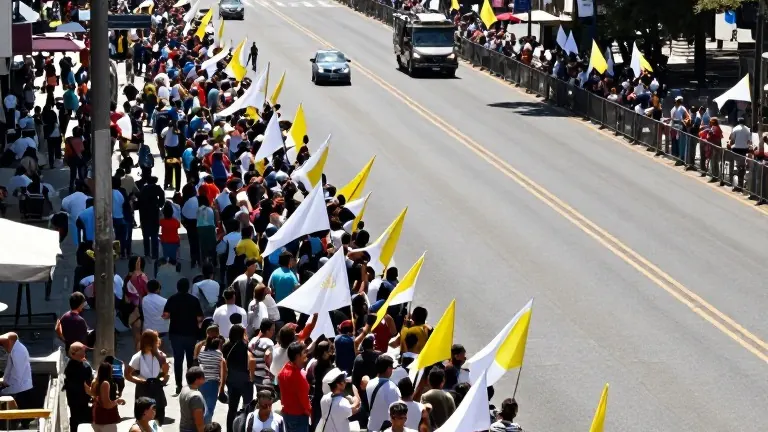
Pope Leo celebrated an outdoor Mass for a record crowd of 2.5 million people on Avenida del Libertador on Monday. This marked the largest event of his 12-day tour of South America and his first visit to Argentina in nearly four decades.
The 71-year-old pontiff arrived in an open-top vehicle under sunny skies. He described the gathering as a source of joy, noting that he could see the enthusiasm of the faithful on their faces. The Vatican characterized the multi-country trip as a homecoming, given Leo’s decades of missionary work in Peru.
Leo arrived in Argentina on Sunday after visiting Uruguay. He will depart for Peru on Wednesday before returning to Rome on November 17. The tour involves 50 events across three nations and takes place less than one month after the pope underwent lung cancer surgery.
During his sermon, Leo addressed the social conditions of Argentine families. He cited instability, precarious employment, and domestic violence as ongoing struggles. He also noted the impact of addictions on young people and family relationships.
On Sunday, the pope met with President Javier Milei. Milei, a libertarian ally of US President Donald Trump, has implemented an austerity agenda that critics say cuts social services. Leo urged the president to protect the poorest and to exercise caution with his rhetoric.
Before the Mass, Leo visited the Pequeno Cottolengo Don Orione care center for people with disabilities. Religious director Jorge Silanes stated that the visit carried added weight because government spending cuts have reduced disability benefits. Leo remarked that a nation's progress is measured by how it welcomes people with disabilities and particular needs.
The Vatican confirmed that Leo met with five survivors of clerical sexual abuse in Buenos Aires on Monday. The meeting lasted more than an hour. Leo listened to their testimonies and spoke individually with each person about paths of healing.
Vatican officials expressed their desire to strengthen protection and support within the church. They acknowledged the difficulty of creating a single abuse-reporting law across different countries while arguing that removing priests can place them beyond supervision. Some survivors had called for a global zero-tolerance policy for clergy with credible accusations.