Curtin University researchers report finding fossilized red blood cells in 115-million-year-old dinosaur bone
Analysis of Aratasaurus leg bones reveals structures resembling red blood cells and traces of heme, challenging previous assumptions about organic preservation in deep time.
By Ricardo Whitaker ·
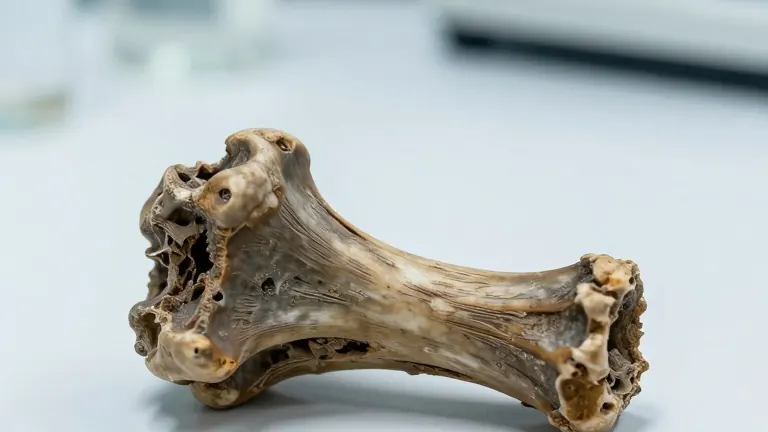
Prof Kliti Grice of Curtin University led a team that identified structures resembling red blood cells within the hind leg bones of an Aratasaurus dinosaur. The specimen, which lived in what is now north-eastern Brazil 115 million years ago, was originally excavated from a mine in 2008 and is currently housed at the National Museum of Brazil. The research team analyzed the bone using electron microscopy to examine fine channels where blood vessels once ran.
The study reports the discovery of small, round structures inside these channels that match the morphology of red blood cells. Chemical tests conducted on the bone material identified the presence of heme, the organic compound responsible for oxygen transport in hemoglobin. The researchers also detected traces of amino acids associated with collagen, a protein found in connective tissues. These findings were published in the Proceedings of the National Academy of Sciences.
Grice stated that the team observed a mineral and molecular echo of the dinosaur’s original biology. She noted that fossilized red blood cells with distinct chemistry related to heme have never been found in situ in any fossil before, describing the discovery as a world first. The presence of a manganese compound called hausmannite may have stabilized the biological material prior to fossilization. Grice suggested this process helped preserve both the cellular structures and the amino acids.
The findings have already generated debate among paleontologists regarding the limits of organic preservation. Prof Mary Schweitzer of North Carolina State University expressed skepticism about the identification of the structures as red blood cells. Schweitzer pointed out that dinosaur red blood cells typically possess a nuclear bulge that creates a dome-like shape on both sides. The structures identified by Grice’s team are concave, a feature that suggests they may be different biological entities.
Schweitzer acknowledged that the detection of heme and collagen amino acids in the bone was persuasive. She noted that conventional wisdom in paleontology, which held that endogenous organics disappear within a million years, is being challenged by new technological approaches. She added that exceptionally well-preserved fossils offer a wealth of new data for researchers to analyze.
Grice urged caution in interpreting the results, emphasizing that the work does not imply that large biological molecules like proteins or DNA survive in ancient fossils. She stated that extraordinary claims require extraordinary analytical evidence. The goal of the research is to determine how much genuine molecular information deep time can preserve rather than to seek specific genetic material.
The research team suggests that museum collections around the world may contain similar molecular information in existing fossils. Grice indicated that the real implication of the study is that old specimens may hold new answers for researchers asking new questions. The work provides a potential new avenue for investigating dinosaur metabolism and activity levels.
More Business · Watch Your Wallet · Report a business · Got a Story?