Army Detonates 5 Tons of Unstable Lead Chemicals in Iowa
A cloud of lead dust is expected to drift up to 100 miles north, prompting evacuations in Middletown and school closures in nearby communities.
By Adrian Romano ·
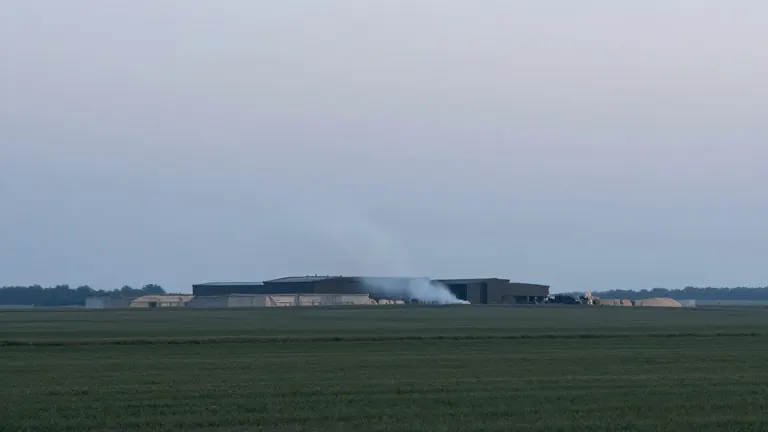
The U.S. Army will detonate approximately five tons of lead azide at the Iowa Army Ammunition Plant on Friday, November 20. The chemical, used in munitions production, has become unstable after more than two decades of storage. Officials warn that the blast will release a plume of lead-containing particles into the air, creating a potential health hazard for residents in southeast Iowa.
Residents in the town of Middletown, which has a population of nearly 400, were advised to evacuate on the morning of the detonation. Those unable to leave their homes were instructed to stay indoors with all windows and doors closed. The Army released maps indicating that the dust cloud could drift north for up to 100 miles. Schools located in the path of the plume have canceled classes, and the Mediapolis Community School District will close its buildings Friday, including the public library.
Lead azide was stored in barrels covered with earth and submerged in a bath of ethanol and water. A routine inspection earlier this year revealed that water had evaporated, causing the chemical to crystallize. This process made the material highly sensitive to friction and shock. An emergency permit approved by the Environmental Protection Agency on November 13 described the situation as creating a highly unstable and dangerous condition. Moving the barrels posed a risk of accidental detonation, particularly in cold weather.
Lt. Col. Daniel Nosse, the commander of the plant, stated in March that the safety of personnel and neighbors was non-negotiable. The Army formed a panel of experts in munitions chemistry, engineering, and environmental safety to design the detonation plan. Concrete barriers surround the barrels, which are buried under soil. Sand barriers stand two stories high around the site. During the blast, crews will spray the soil with water and mist the air to keep lead particles on Army property.
Communities outside the immediate blast zone received late notice of the potential exposure. The EPA permit required the Army to notify the public five days in advance. Notifications went out on Sunday to areas up to 100 miles away. In Mediapolis, located less than 20 miles northeast, city officials learned of their exposure risk when the dispersion map was released. Deputy City Clerk Amy Stucker said the lack of information was the biggest issue for residents. The EPA will operate a command center in Mediapolis to sample air, soil, and water. The city will also conduct its own testing.
Justine Barati, a public affairs specialist at the Army Sustainment Command, expressed concern about the weather conditions leading up to the detonation. She noted that the risk of the chemical detonating on its own increases in cold weather. The vibrations from the two blasts are expected to be quick but may break old windows in the surrounding town. The resulting dust is expected to linger for no more than one hour, depending on wind speed. Officials recommend washing cars and cleaning outdoor surfaces after the event.
Patrick O’Shaughnessy, a professor at the University of Iowa’s Department of Occupational and Environmental Health, noted that lead is a neurological toxicant. He emphasized that young children are particularly vulnerable because they may put objects in their mouths. Environmental and public health officials in Illinois urged the military to conduct comprehensive sampling in their state following the detonations. Governor Kim Reynolds’ office stated that they were first briefed on the public advisory on Monday, November 16.
The Army considered alternatives such as neutralizing the chemicals in the drums. Officials determined that any plan involving handling the barrels would increase the probability of a fatal accidental detonation. The EPA approved the emergency permit to allow for the controlled detonation. The goal is to minimize lead exposure through an abundance of caution. The detonation is scheduled for Friday morning.