Carney and Sheinbaum meet in China as U.S. trade talks stall
Canadian and Mexican leaders discussed bilateral trade growth in Shenzhen while facing stalled negotiations with Washington.
By Adrian Romano ·
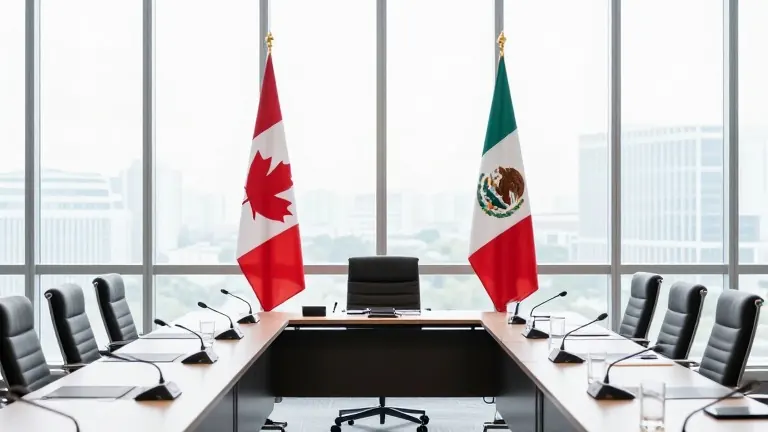
Prime Minister Mark Carney and Mexican President Claudia Sheinbaum met Tuesday in Shenzhen, China, to discuss trade strategy as negotiations with the United States remain stalled. The leaders convened on the sidelines of the Asia-Pacific Economic Co-operation summit. Both nations face similar challenges from the current U.S. administration, which has imposed heavy tariffs and created uncertainty in trade talks.
Carney stated that Canada and Mexico see many opportunities for further cooperation and working with global partners, including the United States. Sheinbaum spoke in Spanish about the importance of the extraordinary relationship between the two countries. She said the meeting allowed them to discuss continental trade and a possible agreement between the three nations.
The two governments signed an action plan for deeper ties during Carney's visit to Mexico in September 2025. Carney reported that 120 initiatives from that plan have been completed. Trade between Canada and Mexico has increased by 18 percent compared to the previous year. The prime minister described this growth as an indication of the strength of the relationship and the scale of the opportunity between the two economies.
Both countries have experienced similar outcomes in their dealings with U.S. President Donald Trump. Despite differing approaches, they continue to face significant tariffs and threats of new duties. Trade talks for both nations were sidelined by the interference of a close Trump ally and administration official.
Reports indicate that U.S. Commerce Secretary Howard Lutnick created an impasse in Mexican trade talks last month. Lutnick was also blamed for the late-stage breakdown in negotiations with Canada in August. Ottawa and Mexico City had been negotiating with U.S. Trade Representative Jamieson Greer. Greer stated his goal is to have interim limited agreements by the end of the year. However, Lutnick intervened in both sets of talks and refused to budge over sector-specific tariffs on goods like automobiles.
Canada and Mexico are seeking a pathway to renew the trilateral trade pact, known as CUSMA. The goal is to bring predictability and tariff relief back to their economies. The Trump administration chose not to renew CUSMA in July. That decision triggered a rolling annual review for up to a decade. The agreement will expire if the three countries cannot agree on an extension by that time.
Andrea Van Vugt, a foreign-policy adviser to former prime minister Stephen Harper, noted that the negotiation process has become complicated. She told a panel discussion for the Washington International Trade Association on Monday that it is not just Ambassador Greer involved. She said the process also involves Secretary Lutnick, the president's office, and the president himself. Van Vugt, the chief operating officer of Wellington Advocacy, called it a really hard dynamic to negotiate in. She added that it makes it very hard to understand how to bring a negotiation to conclusion.
Van Vugt said the goal for Canadian negotiators is to preserve as much of the trilateral trade pact as possible while lifting tariffs. She noted it is not clear how much of that is possible. Trump escalated the trade war this summer by hitting an array of Canadian goods with 50 percent tariffs and banning the import of others after talks broke down. Ottawa responded with retaliatory tariffs. Mexico has not retaliated with its own round of levies.
Kenneth Smith Ramos, the former Mexican chief negotiator during the first Trump administration, said Sheinbaum's initial goal was to get tariffs dropped before CUSMA negotiations started. Mexico worked with the Trump administration on human and drug trafficking issues. Ramos, a partner at Mexico City-based Agon, said Mexico did not see duties decrease and was not given an indication of preferential tariff treatment. He described the U.S.-Mexico discussion as a game of chicken.
Antonio Ortiz-Mena, the former minister for economic affairs at Mexico's embassy in the United States, said it is positive that many goods compliant with CUSMA are not being hit with levies. He added that tariff threats are always changing. Ortiz-Mena noted that Mexico is under investigation for new duties related to overcapacity. He asked at the panel if the goal post is moving and what else the U.S. wants.